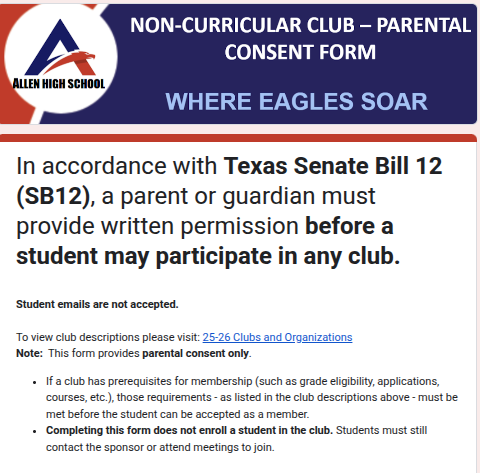
As of Sept. 1, 2025, Allen High School is required to have parent permission for students to participate in school-affiliated clubs. This is a statewide mandate called Senate Bill 12, and all public schools in Texas for the 2025-26 school year must adhere to it.
SB 12 mandates increased parental oversight in PreK through 12th grade in public schools, requiring written consent from their parent or guardian. The law also prohibits public schools from supporting clubs promoting ideas of gender identity.
“[Allen ISD is] just going to follow all school state mandates that are out there dealing with general gender,” said JD Walker, the coordinator of student leadership and engagement. “We have to comply with whatever the state tells us to do, as far as that’s concerned.”
Allen High School administrators say they have updated their policies to comply with the law and have found their own system to manage school organization guidelines with a school of over 5,000 students.
“There’s a parent consent form that our district came up with, and I think they did an outstanding job,” Walker said. “It’s attached to the club and organization on our website. All [parents] have to do is say… they want to give their student permission to go to robotics. You’ll see robotics. You’ll see who the sponsor is, you’ll see what robotics does. And then it’s got a parent consent form.”
State lawmakers who support this new law say it helps parents understand what their child is involved in and learning about at school.
“The legislation further upholds parental authority by giving them the ability to opt their child in or out of specific programs, such as the requirement in this bill that a parent must opt in to a child’s sex education curriculum, and this is so that parents can make informed choices that align with their family’s values,” State Rep. Jeff Leach told The Texas Tribune.
Critics of this new law argue that these new policies create obstacles for students when it comes to seeking support and learning about their identity through a school community. They argue that inflicting parent consent forms could discourage students from wanting to join clubs where they could otherwise find support and learn about their identity. They contend that this law is particularly harmful for students who anticipate or experience a lack of support from their own families.
“Let’s be clear: Senate Bill 12 is not about protecting students — it’s about enforcing a narrow vision of who belongs in our state,” advocacy strategist for LGBTQ+ rights at the American Civil Liberties Union (ACLU) of Texas Ash Hall told The Texas Tribune.
“This bill not only violates students’ constitutional rights, it also aims to censor the truth, whitewash history, and punish educators for fostering a welcoming environment where every student can thrive.”
The ACLU and other civil right organizations have warned that the law has the potential to isolate students who seek support from school based spaces. Hall adds that without these programs, students might struggle finding belonging in school environments.
“Without [diversity, equity, and inclusion], you’re going to see more students who might think that they are alone,” Hall said.
Teachers, staff and students are accommodating to this new legislation. “[The new law has] been challenging,” Walker said. “It’s a hurdle that we have to overcome. But I think things are going really well. It’s all about structure, and [now] we’ve got some new structures. But once those structures and stuff are in place, [it will be] pretty seamless.”
Allen ISD wants to ensure that the balance of the law, education of its students and the opportunities for students to engage and be with their community do not imbalance each other.
“I appreciate all of the sponsors and staff that are involved to help our students because most of [them are] volunteers,” Walker said, “Our sponsors do a great job with keeping up with all of the new [laws].”